

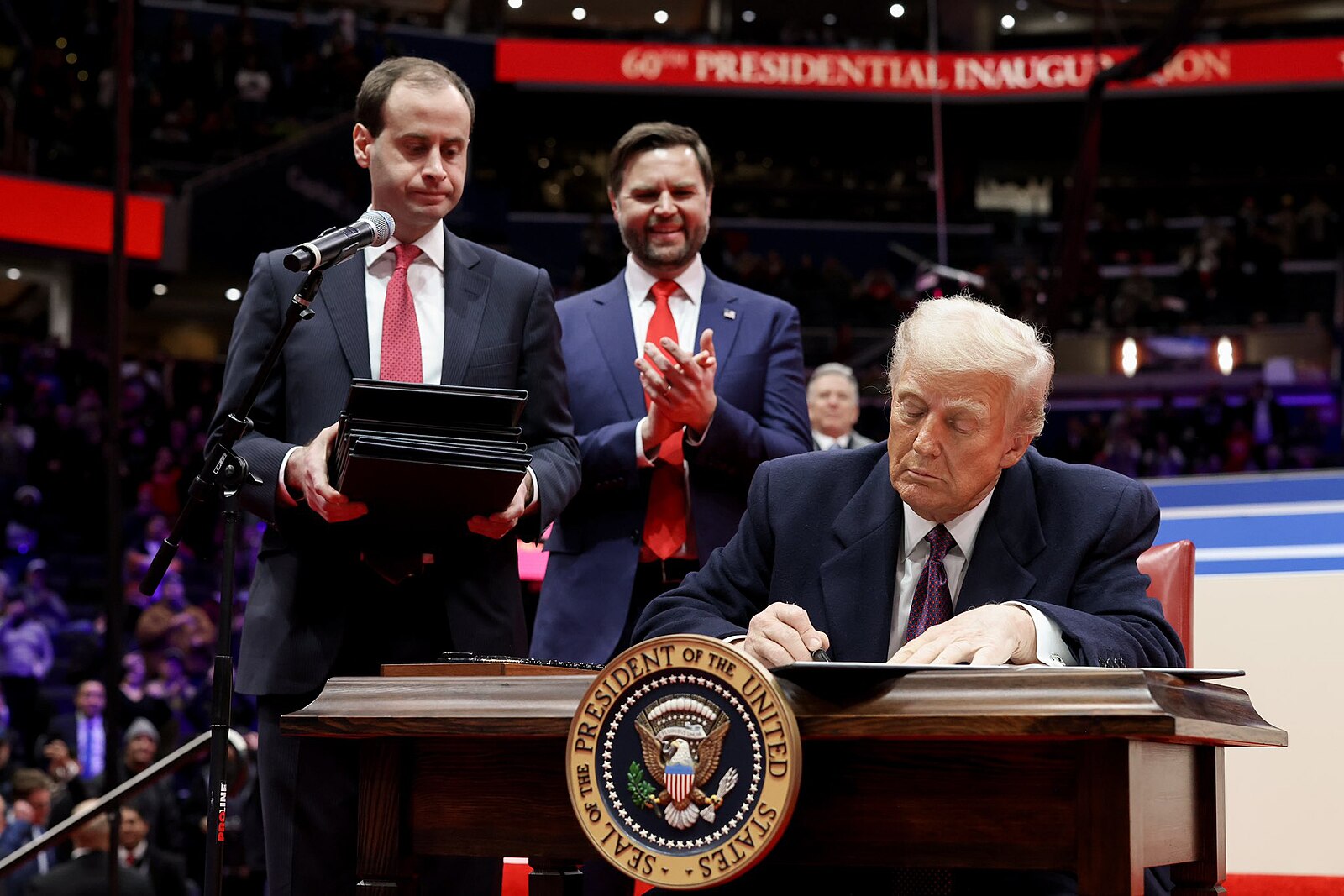
While investors, board members, and CEOs of publicly traded corporations say DEI is a business imperative, the Trump administration continues to escalate the ideological war on DEI.
By Nancy Levine Stearns | January 7, 2026
The Trump administration Department of Justice (DoJ) has launched investigations into corporate giants including Google and Verizon over companies’ diversity, equity and inclusion practices (DEI), the Wall Street Journal reported last month. The administration is leveraging a Civil War-era fraud statute to investigate DEI initiatives of America’s most prominent corporations, Black Enterprise reported.
The investigations mark the latest attack in the Trump administration’s war on DEI. On Day One of his second presidency, Trump issued an executive order targeting DEI in publicly traded corporations. The order hinged on the specious argument and debunked theory saying merit and diversity initiatives are opposed.
Despite messaging from investors, boards and CEOs about the business imperative of DEI, as supported by data and research, the Trump administration continues to escalate its ideological war against America’s largest corporations.
Investors, boards, CEOs say DEI is a business imperative
Alex Gorsky, former Chairman and CEO of healthcare giant Johnson & Johnson and current board member of JPMorgan Chase, Apple, and IBM, made the case for diversity and inclusion as a business imperative in an essay he penned several years ago.
As former Chair of the Business Roundtable’s Corporate Governance Committee, Gorsky wrote in 2019:
“Extensive research shows that companies that prioritize diversity and inclusion are more successful, profitable and innovative.” He concluded, “Advancing diversity and inclusion in corporate America depends on leadership at all levels. The companies that invest in diversity and inclusion today will be the most innovative, sustainable and prosperous tomorrow. By accepting this shared responsibility, together we can seize a tremendous shared opportunity to create a more vibrant U.S. economy where all Americans can realize their potential.”
The Business Roundtable is an association of more than 200 chief executive officers (CEOs) of America’s leading companies, representing every sector of the U.S. economy. “Business Roundtable members develop and advocate directly for policies to promote a thriving U.S. economy and expanded opportunity for all Americans,” according to their website.
A Business Roundtable webpage called “Statement on the Purpose of a Corporation” currently says: “While each of our individual companies serves its own corporate purpose, we share a fundamental commitment to all of our stakeholders, saying, “We foster diversity and inclusion, dignity and respect.”
Gorsky’s business case for DEI was echoed by leaders in 2025. Chairman and CEO of pharmaceutical giant Merck, Rob Davis, told shareholders during a Q&A session at the company’s annual meeting last May that diversity and inclusion initiatives are “a strategic imperative.” Merck shareholders voted by a tally of 99-1 percent to reject an anti-DEI proposal.
Merck was not alone. In 2025, investors in corporations collectively worth more than $13 trillion underscored the message: DEI is a business imperative.
Shareholders of 31 out of 31 corporations, including Apple, Coca-Cola, and Disney, voted to reject anti-DEI proposals in 2025, most by 98-99 percent of voting shares. Most recently, shareholders of tech giant Cisco voted against an anti-DEI proposal last month by a tally of 99-1 percent of voting shares.
The Trump administration is now targeting the mechanisms of shareholder democracy itself. The president issued an executive order late last year targeting the two largest proxy advisor firms, taking aim at DEI and ESG (Environment, Social, Governance) corporate initiatives.
Research and data show DEI is a business imperative
While anti-DEI proposals presented to corporations by conservative nonprofit groups in 2025 focused largely on legal risks arising from potential litigation — which the proposal presenters themselves seem hopeful to spur — research shows that risks of retreating from DEI are weighty.
A 2025 study, Risks of retreat: The enduring inclusion imperative by Catalyst and the Meltzer Center for Diversity, Inclusion, and Belonging at NYU School of Law, revealed companies that retreat from DEI incur risks along four pillars: financial, legal, reputation, and talent.
In the plus-column, a study released last year by the Human Rights Campaign and Whistle Stop Capital, analyzing 15 years of data, showed that companies that embraced LGBTQ+ inclusion policies reaped positive financial performance across multiple metrics, including higher revenue, stronger profits, and steadier market performance.
A 2023 study from shareholder advocacy group As You Sow revealed “a diversity benefit” in publicly traded corporations. Higher percentages of BIPOC (non-White) management are positively correlated with increases in enterprise value growth rate, free cash flow per share, income after tax, long-term growth mean, 10-year price change, mean return on equity (ROE), return on invested capital (ROIC), and 10-year total revenue compound annual growth rate (CAGR).
Dr. Solange Charas, Professor of Practice at Columbia University School of Professional Studies wrote for Forbes, “investors want to see how companies are managing their people as a way of driving higher profitability and market value, employees want to know that their development and well-being are prioritized, and customers increasingly care about how companies treat their workforce as a deciding factor in purchasing intent.”
Dr. Charas has developed proprietary approaches for quantifying the return on investment of human capital (HCROI); her academic research focuses on the relationship between human capital management and financial performance. Dr. Charas told Impactivize in an interview, “Human capital must drive profitability,” and “diversity is profitable.”
Shari Dunn, J.D., author of the book Qualified: How Competency Checking and Race Collide at Work (HarperCollins), wrote in a message to Impactivize: “Businesses must reclaim the fiduciary and business-imperative discussion because it has been wrongly reframed as a question of political exposure rather than corporate responsibility. Fiduciary duty obligates executives to act in the long-term interests of the company and its shareholders, which necessarily includes recruiting and retaining talent, mitigating risk, driving innovation, and understanding an increasingly diverse consumer base.”
The Holy War against DEI
By attacking DEI in the private sector, the Trump administration is implementing the ideological agenda of the Heritage Foundation’s Project 2025, a 920-page manifesto.
“In the months leading up to his election, President Donald Trump insisted that he had nothing to do with the Heritage Foundation’s far-right vision for his second administration known as Project 2025, a Christian-nationalist blueprint to remake the federal government,” the 19th reported.
The U.S. federal government is not masking its commitment to Christian nationalism. Vice President JD Vance said in a speech last month: “By the grace of God, we always will be a Christian nation.”
Trump administration’s OMB (Office of Management and Budget) Director Russell Vought helped launch Heritage Action, the dark money arm of the Heritage Foundation. Vought “chaired the transition portion of Project 2025,” and once said, “We were meant to be a Christian nation,” ProPublica reported.
But the Project 2025 agenda is not limited to government. The Heritage Foundation established a capital markets initiative last year, led by anti-DEI crusader Robby Starbuck, apparently to impose its Project 2025 Christian nationalist agenda on American corporations.
In the Project 2025 chapter about the FTC (Federal Trade Commission), author Adam Candeub incorrectly calls DEI in publicly traded corporations “moral beliefs” (Page 874).
As for his credibility, Candeub called the 2020 election “crooked.” He wrote about the January 6 attack on the U.S. Capitol: “There was no insurrection. There was a political demonstration to protest a crooked election that got out of control.” Seven deaths were linked directly to the Jan. 6 attack, NPR reported.
Candeub now serves as general counsel of the FCC (Federal Communications Commission), chaired by Brendan Carr who authored the Project 2025 chapter about the FCC.
Carr deployed extortion-type tactics against Verizon in 2025, blocking their acquisition deal unless the company eliminated its DEI programs. Verizon capitulated, and the FCC approved the company’s deal. Now, Trump’s DoJ has targeted Verizon for investigation anyhow.
Weaponizing levers of government against corporations
Assistant Attorney General at the Department of Justice’s Civil Rights Division Harmeet Dhillon testified in July before the U.S. Senate Judiciary Committee, saying, “The goal is clear. Either DEI will end on its own, or we will kill it.”
Sen. Eric Schmitt (R-MO), who chaired the Senate subcommittee hearing, attacked what he called corporate “rebranding” DEI, referring to companies that now call DEI initiatives, for example, Belonging, Inclusion, Culture, etc.
Dhillon, who heads the civil rights division responsible for protecting disabled workers, hurled a slur against influencers on X last month, calling them “r*tards.” Sen. Schmitt, who has a severely disabled autistic son, and has worked to advocate for autistic people, has not commented on Dhillon’s use of the slur.
Dhillon testified at the hearing that the DoJ would be working hand-in-hand with the EEOC (Equal Employment Opportunity Commission) to “kill” DEI.
Trump-appointed EEOC Chair Andrea Lucas posted on X last month, recruiting white men to file claims against their employers for discrimination, dangling the possibility of monetary incentive. But Lucas’s X account is not the EEOC’s only recruiting channel.
A legal group cofounded by Trump senior advisor Stephen Miller has acted as a farm system for anti-DEI complaints. Most recently, America First Legal (AFL) filed a letter of complaint with the EEOC against publishing giant Penguin Random House (PRH) over its DEI initiatives.
“The group has previously filed more than 100 legal actions against other ‘woke’ companies such as Disney, Nike, and Mattel for their DEI policies, which AFL alleges discriminate against white men,” reported Publishers Weekly.
In a noticeable overlap, Trump filed a lawsuit against PRH over its publication of Lucky Loser: How Donald Trump Squandered His Father’s Fortune and Created the Illusion of Success (Penguin Press).
Daniel Epstein, who is representing Trump in the Lucky Loser lawsuit, is Vice President of AFL and has also represented Trump in other lawsuits, including cases against CBS and the recent case against the BBC.
A PRH spokesperson called Trump’s lawsuit “meritless” and said that the publisher “will continue to stand by the book and its authors just as we will continue to stand for the important fundamental principles of the First Amendment.”
Also about the First Amendment, Shari Dunn messaged: “Under Citizens United, corporations possess First Amendment rights to political speech and routinely exercise those rights through campaign spending, lobbying, and public advocacy to protect their economic interests. Attempts to restrict or chill a company’s ability to engage in lawful, nondiscriminatory DEI practices therefore run directly counter to that principle.”
CEOs of the Business Roundtable
State attorneys general from Missouri and Arkansas led 14 Republican AGs, submitting a letter last year to Joshua Bolten, CEO of the Business Roundtable, urging the organization’s 200-plus member CEOs to abandon DEI initiatives.
The letter baselessly stated, “We write to urge the Business Roundtable’s member CEOs to abandon the unlawful and misguided DEI initiatives that have for too long harmed businesses and consumers alike.” The Business Roundtable did not publicly respond to the letter.
Given the Trump administration’s penchant for retaliation, with few exceptions, CEOs have been hesitant to paint a target on their company by defying the president or his allies by reiterating the business case for DEI.
But there are exceptions. Demonstrating the kind of leadership that Alex Gorsky called for in his essay, Tarang Amin, CEO of e.l.f. Beauty (NYSE: ELF), posted on LinkedIn about his interview last year with CNN’s Erin Burnett. Amin wrote:
“Erin asked if it takes courage to maintain this mission, and while it does, I’ve yet to meet a CEO who isn’t committed to fostering a high performing and diverse workforce. At e.l.f., we believe the diversity of our team is one of our greatest strengths, contributing to 23 consecutive quarters of net sales and market share growth.”
The Business Roundtable is in a unique position to leverage the collective voices of more than 200 CEOs for the benefit of shareholders and stakeholders.
Shari Dunn messaged: “The Business Roundtable, in particular, is positioned to assert this [message] collectively—and it should.” She added, “Defending DEI is not political defiance; it is the exercise of corporate free speech, fiduciary duty, and free-market self-preservation.”
No one from the Business Roundtable responded to inquiries.